
 David
David 
by David Boyle
Anchorage School District Goes the Wrong Direction in Reading Proficiency
In a recent board meeting the district presented data that showed that 3rd grade students were losing ground in their reading progress.
The board’s goal is that the percentage of grade 3 students proficient in reading on the state summative assessment, the AK STAR, will increase from 32.4% in May 2023 to 46.4% in May 2028.
The AKSTAR is the test (summative) students take towards the end of the school year and is one measure of a student’s academic success. You can find all about the AKSTAR here (https://education.alaska.gov/assessments/akstar).
And the Alaska Reads Act, passed in 2022 by the legislature, ensured that our students were taught using the Science of Reading. Both the AKSTAR and the Reads Act should have help ensure our students were being at least taught how to read.
Unfortunately, the AKSTAR scores for ASD 3rd grade students have gone down since 2023 and the trend doesn’t look good.
Here are the data presented by the ASD administration:
Note that each year has a different cohort (group) of 3rd grade students.
These data pretty much speak for themselves. But why are ASD students becoming less literate as the Reads Act is implemented? Are these students less prepared to learn to read when entering school?
Let’s look at the student demographics to see if we can discern what is happening in the various student groups. Here is a chart showing the demographics and AKSTAR scores of the 2023-24 and the 2024-25 3rd grade students:
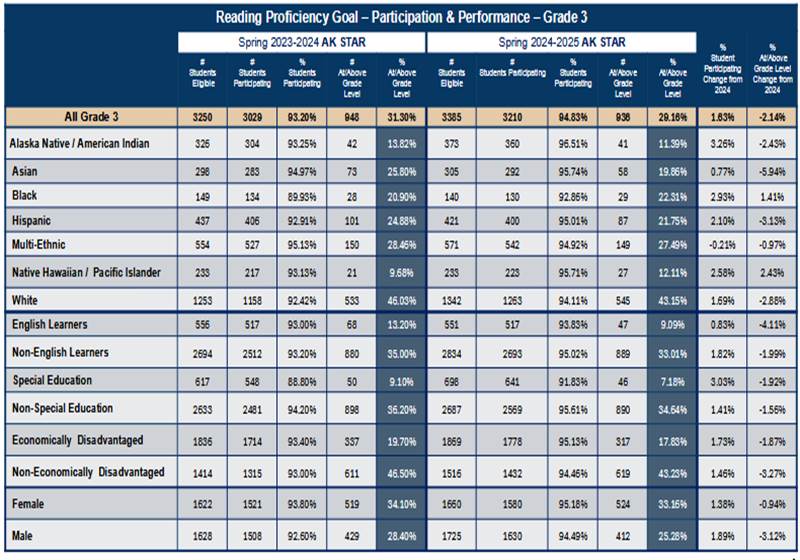
Just focus on the columns that are in dark blue-they show the percentage of students at/above grade level in reading for years 2024 and 2025.
The most significant numbers show that both Asian and White students losing ground while Black and Pacific Islander students gain ground. Could this be the result of the implementation of Equity programs in the district where resources (teachers) are moved from one class/school to another?
Or is the decline of AKSTAR scores in the White and Asian students due to those parents removing their students from the district?
Whatever the reason this is not good news for the district and worse news for the students. And it is a virtual impossibility for the district to reach its goal of 46.4% of students being proficient in reading in 2028. Why can’t the district teach even half of our students to read by the 3rd grade?
Let’s look at the other Big 5 school districts, Fairbanks, Juneau, Kenai, and the MatSu. How are their students doing on the AKSTAR? Glad you asked!
AKSTAR Scores, 2023-2025:
| DISTRICT | 2023 | 2024 | 2025 |
| KENAI | 29.2 | 30.6 | 34.3 |
| MATSU | 33.4 | 36.3 | 37.6 |
| FAIRBANKS | 24.9 | 30.7 | 34.4 |
| JUNEAU | 27.2 | 26.9 | 30.1 |
| ANCHORAGE | 32.4 | 31.3 | 29.2 |
Here is a bar chart where one can see the trends in teaching our kids how to read. Note that the only district with a downward trend is the Anchorage School District.
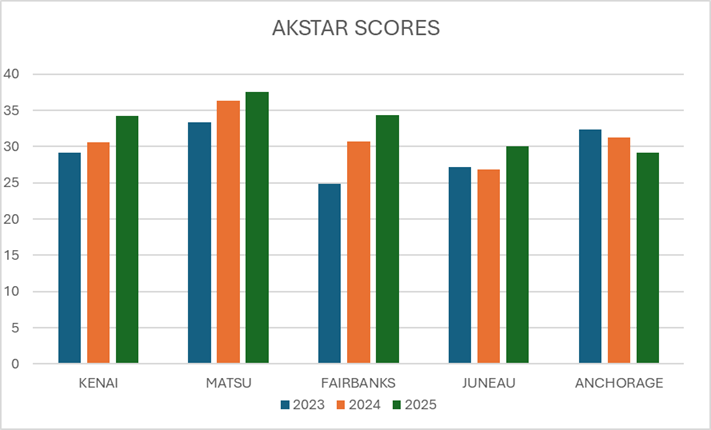
Four of the Big 5 school districts are improving in teaching their students how to read using the AKSTAR as the metric.
Only the Anchorage School District is failing to teach more of its students how to read in successive years using the same metric. The trend line is downward.
What is going on? Are the Anchorage students not as smart? Are the Anchorage teachers not as adept at teaching? Is Anchorage leadership not as engaged in teaching its students how to read? Is the Alaska Reads Act being implemented with fidelity?
We must teach children how to read so they can “read to learn” in the later years. Students that cannot read at grade level have a much higher chance of dropping out during their teen years.
Illiterate students are stolen futures.
There may be many reasons why the ASD is not moving forward in its goals to teach kids how to read. Money is not one of them. Four of the Big 5 districts seem to be able to teach their children how to read with current funding.
Let’s reward those districts that are successful at teaching their students how to read. Reward success; not failure.
That’s the least we can do for our children.