
SB 277 Delivers Real Wins for Alaska’s Homeschool Families — But Two Fixes Are Still Needed Before It Moves Forward
 David
David 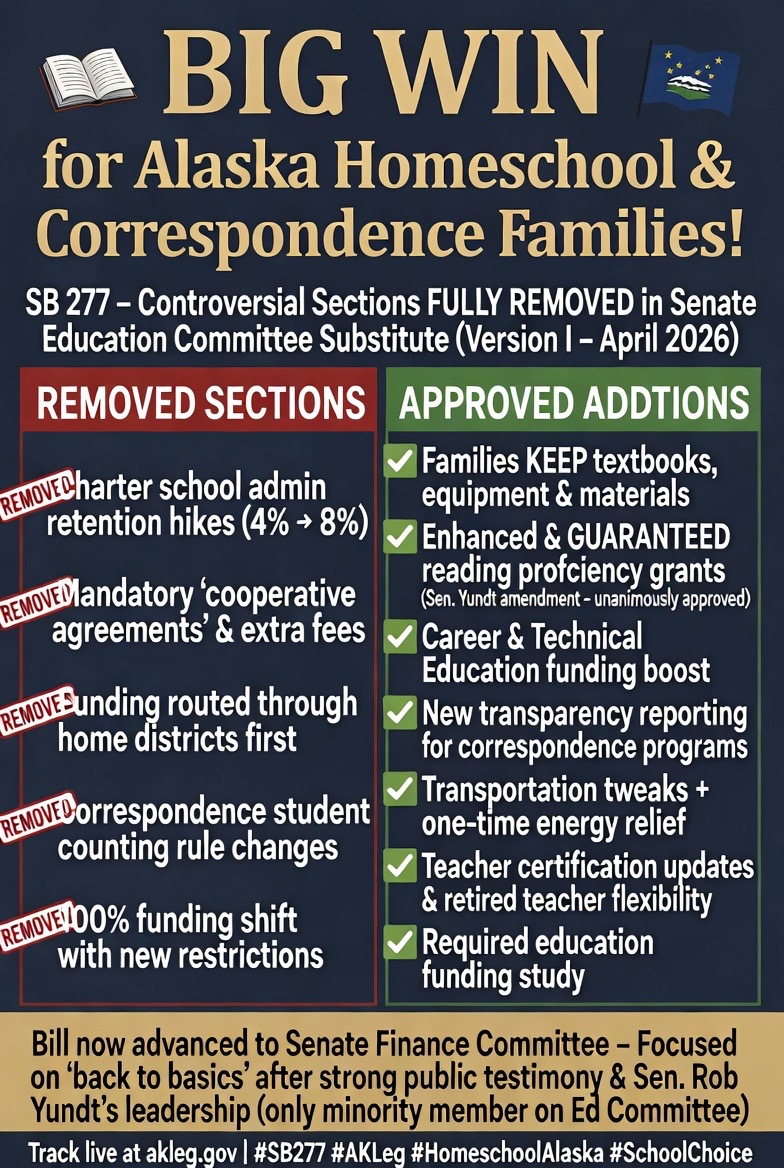
By Barbara Haney, Phd.
For months, Alaska’s correspondence and homeschool families watched Senate Bill 277 with growing alarm. The original version threatened to reroute tens of millions in student funding through local districts, impose new “cooperative agreements” and extra fees, hike administrative skims on charters, and fundamentally alter how correspondence students are counted. It felt like a direct assault on the school-choice model that serves more than 23,000 Alaskan students and has long been one of the most successful in the nation.
That’s why the news from the Senate Education Committee this month is worth celebrating.
Thanks to the thousands of homeschool and correspondence families across Alaska who wrote in, submitted powerful written testimony, and showed up to testify — combined with the persistent work of Sen. Rob Yundt (R-Wasilla), the lone minority member on the committee — the most damaging provisions were completely removed in the latest committee substitute (Version I). Sections that would have forced funding through home districts first, required new cooperative agreements with uncapped extra charges, doubled administrative retention on charters, and changed student-counting rules are gone. The bill no longer contains the 100% funding shift with strings attached that would have clawed back money from popular statewide correspondence programs like Galena, IDEA, and others.
That is a major victory for educational freedom. Your voices were heard. Lawmakers listened. The bill has now advanced to the Senate Finance Committee in a much narrower, more focused form centered on “back to basics” — exactly as Sen. Yundt described in his recent letter to constituents.
Additional pro-choice and pro-family provisions remain intact and are worth supporting:
- Families can still keep textbooks, equipment, and curriculum materials purchased with their allotments even after leaving a program.
- Sen. Yundt’s unanimous amendment strengthened reading proficiency incentive grants under the Alaska Reads Act (now guaranteed, not subject to appropriation) and added new support for career and technical education.
- The bill includes targeted transportation tweaks, one-time energy relief funding for districts facing high fuel costs, teacher certification updates, and a required Legislative Budget & Audit study on education funding.
These are practical, common-sense improvements that help students without undermining parental choice.
But the job is not finished. Two provisions in the current version still need fixing before this bill becomes law.
First, the new targeted transparency reporting requirements (new Section 1) apply only to districts operating correspondence programs. While accountability is important, this bill singles out correspondence families — who represent roughly one-fifth of public school students but receive less than 5% of the overall K-12 budget (about $47 million in actual allotments in FY2024 versus $1.4–1.5 billion total). If the goal is truly better oversight and “good policy for all of Alaska’s students,” why not require comparable reporting across the entire system? Singling out the most cost-effective, parent-driven segment of public education sends the wrong message and risks creating a precedent for future restrictions.
Second, the well-intentioned “families keep materials” language (retained Section 2) creates a potential loophole that could be exploited. Families could theoretically enroll, spend their full annual allotment on curriculum and equipment, then withdraw before the official student count date. The program would receive no per-student funding for that child, yet the family keeps everything. While widespread abuse is unlikely, even the perception of vulnerability gives opponents ammunition to argue later that “the allotment system is broken — let’s gut it.” This provision needs a simple safeguard: require repayment or proration of unearned allotments when students withdraw early, or tie final disbursement more tightly to verified enrollment through the count date.
These are not fatal flaws, but they are fixable. The Senate Finance Committee has the opportunity to close these gaps with targeted amendments while preserving the hard-won gains already made.
Alaska’s correspondence programs are a national success story precisely because they trust parents, stretch limited dollars further, and deliver strong results with minimal bureaucracy. SB 277 is now much closer to respecting that model than it was when introduced. With two modest corrections — and with the same grassroots energy that got us this far — it can become a true bipartisan win that strengthens public education without punishing the families who choose the most innovative, flexible path.
Finance Committee members: Please protect the victories already achieved, close these remaining loopholes, and honor the thousands of families who stepped up to defend educational choice. Homeschool and correspondence families are watching — and we are ready to support a bill that truly works for all Alaska students.
Contact your senator today and urge them to support targeted fixes to SB 277. The future of educational choice in Alaska depends on getting this right. You can find your senator and representative here: https://akleg.gov/index.php. Just scroll down the page and put your address in the block.
Track the latest version of SB 277 live at akleg.gov. Public testimony windows in Finance will be critical.