 David
David 
The Alaska Legislature has wrestled with increasing the funding of our K12 system. The mantra of “flat funding for decades” has been replaced by “inflation is causing the system to fail”.
The supporters of more funding with no accountability for results focus on a single funding factor, the Base Student Allocation. They ignore the revenue streams that also fund our K12 system.
This is misleading the legislature and the public. Actually, Legislative Finance says that funding for K12 has increased by 34% since 2006, more than inflation for that same period.
Here are the funding streams that pay for our K12 system:
Direct Funding Indirect Funding
| Foundation Formula (BSA) | PERS/TRS Paid by State |
| Transportation | School Bond Debt Reimbursement |
| Federal Impact Aid | School Construction |
| Federal Title Programs | Major Maintenance Funding |
| Local contributions | |
| E-Rate Funding | |
| Quality Schools Initiative |
The FY24 State aid consisted of $1,151,132,737 (based on the BSA funding formula).
Pupil transportation for FY24 was $70,743,841 which is not included in the BSA formula. Note that for FY25 an additional $7,305,892 was provided outside the transportation funding formula.
In FY24 the federal government provided $88,768,627 in impact aid. This funding comes from nontaxable federal properties as an offset to local tax dollars.
In FY24 the state legislature provided one-time funding of $87,554,016 outside the BSA formula.
Another added revenue stream comes from “minimum required local effort” which requires organized boroughs to kick in a “fair share” to pay for the local schools. For FY24 this totaled $300,641,017.
The E-Rate funding comes from federal funds that every cell and landline user pays for. It used to be called the Universal Services Fund. In FY23 the state received more than $100 Million in E-Rate funds. These funds go to most of the rural schools to pay for the internet and communications. Here is a listing of the schools that received these funds: https://education.alaska.gov/SchoolFinance/pdf/FY25%20School%20BAG%20Funding%20Overview.pdf
The Quality Schools Initiative provides an additional $16 per student count. In FY24 this totaled $4,124,512.
The state received more than $257 Million from the various Federal Title programs in FY23.
Here is a graph and chart from DEED showing Total State Aid & One-Time Funding:
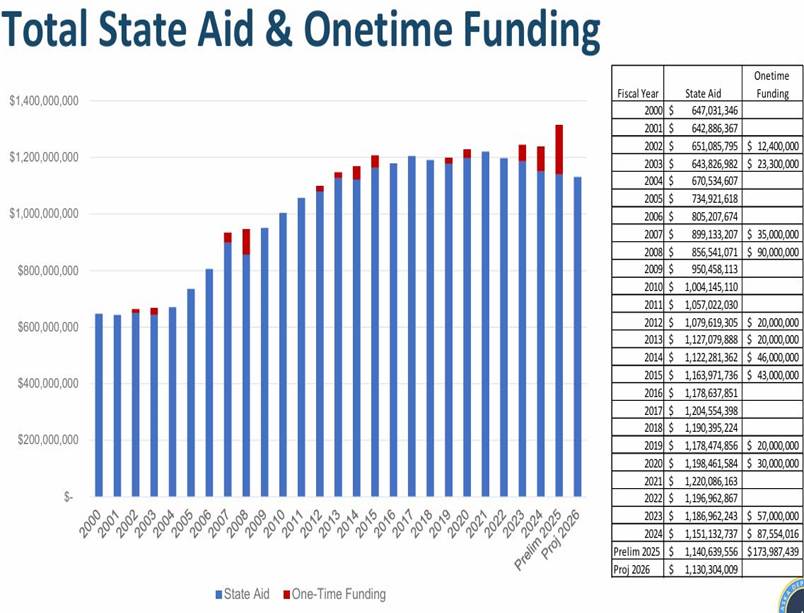
During the Covid “pandemic”, the state received an additional $579,826,453 in federal funding through various legislation. Some of this funding was limited in its use. The question is, “What did all this money do to improve student achievement?”
To its credit, the Department provided great transparency in the allocation and use of these Covid funds: https://app.smartsheet.com/b/publish?EQBCT=0cfd777df5b94c0bbec27cc0631318a4.
The education industry sees the writing on the wall-the number of students is seriously declining and because the state’s funding is based on that number it wants to inflate the funding to the maximum.
State aid is projected to decrease another $36 Million due to the decrease in student enrollment.
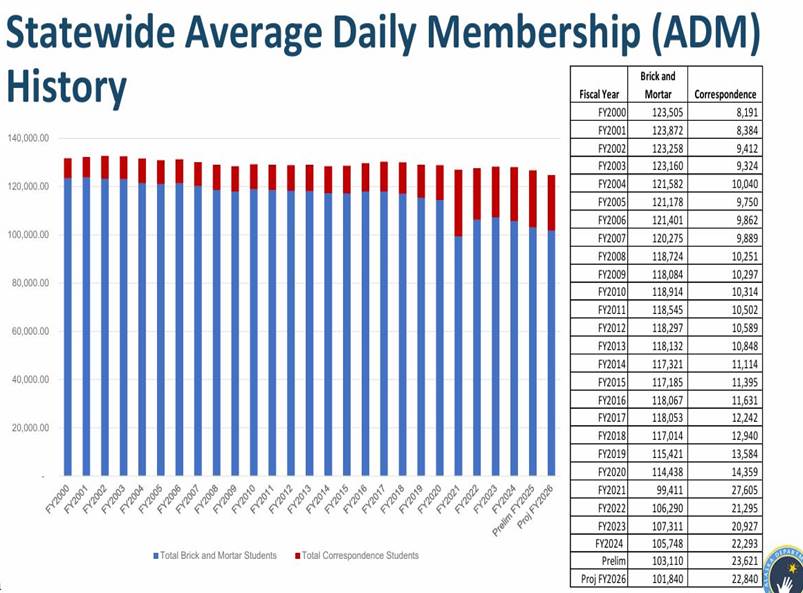
Since 2014 the number of brick & mortar students has decreased by 11,573.
And the number of correspondence students during that same period has gone from 11,114 to 22,293. An astounding increase of 11,179 students. Here is a graph from DEED showing the data from FY2000 through a projected student count for FY2026:
We need accountability for results rather than throwing money at the problem. Incentivizing current bad behavior will only result in the education industry returning to the legislature and asking for even more funding.
The legislature needs to ensure the funds go to the classroom.
What do you think? Are we spending enough? Or do we need to spend more without accountability for results?
You can tell your legislator what you believe. Want to find who your legislator is? Go to this link, scroll down and find “Who Represents Me?”: https://akleg.gov/